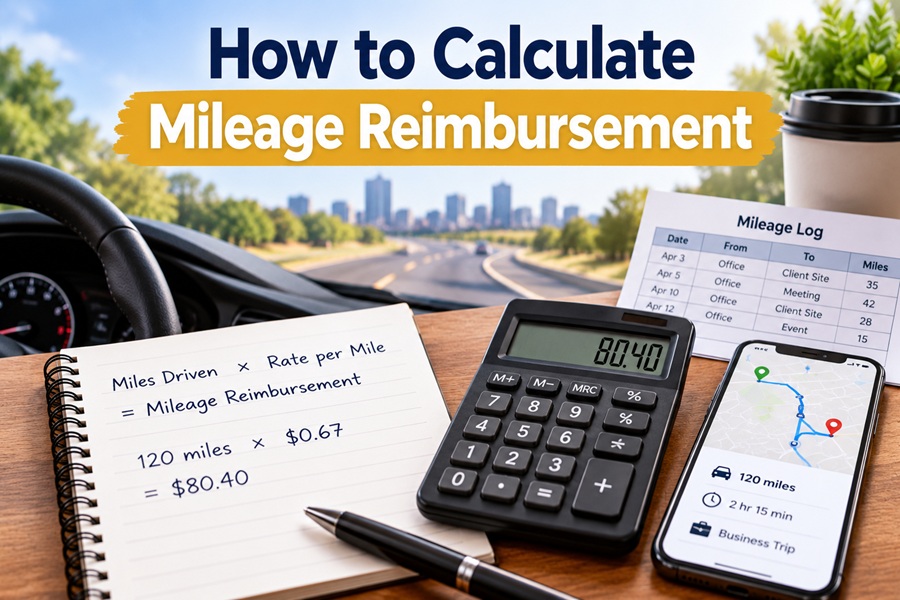
The math behind mileage reimbursement fits on a sticky note. Business miles multiplied by the rate per mile. What trips people up is everything around that formula: which miles count, which rate applies and how to handle a year when the rate changed in the middle.
That last point is not hypothetical. In 2026 the IRS raised its rate partway through the year, so anyone calculating reimbursement this year needs two numbers instead of one.
The Basic Formula
Reimbursement = Business miles driven × Rate per mile
If you drove 300 business miles and your employer reimburses at 76 cents, you would receive:
300 × $0.76 = $228
Simple. Now for the details that decide whether that number is right.
Step One: Know Which Rate Applies
Most employers use the IRS standard mileage rate because reimbursements at or below it are generally tax free. For 2026 there are two business rates.
| Travel dates in 2026 | Business rate | Medical and qualifying military moving | Charitable |
|---|---|---|---|
| January 1 to June 30 | 72.5 cents per mile | 20.5 cents per mile | 14 cents per mile |
| July 1 to December 31 | 76 cents per mile | 23.5 cents per mile | 14 cents per mile |
The IRS set the original 2026 rate in December 2025, then announced a midyear increase for travel on or after July 1, pointing to higher fuel prices. The new rate applies based on when the miles were driven, not when the expense report is submitted.
Your employer is free to choose a lower or higher rate. A lower rate is allowed but may leave you short on actual costs. Any amount paid above the IRS rate for a given trip becomes taxable income.
Step Two: Count Only Business Miles
This is where most calculation errors happen. Business miles generally include:
- Driving from your regular workplace to a client, customer or vendor
- Traveling between two work locations in the same day
- Trips to the bank, post office or supply store for business
- Driving to a temporary work site away from your usual location
Business miles do not include your normal commute between home and your regular workplace. That drive is personal, even if you make a work call on the way.
The commute adjustment. If you drive straight from home to a client site, many employer policies subtract your normal commute distance. For example, if your usual commute is 12 miles each way and you drive 40 miles from home to a client and then 30 miles back to the office, a policy using this rule would count 40 minus 12, or 28 miles, for that first leg plus the full 30 miles to the office. Check your company policy, because practices vary.
Step Three: Log Each Trip
A reliable log includes the date, starting point, destination, purpose and miles. Here is a sample week for a sales representative in early July.
| Date | Route | Purpose | Miles |
|---|---|---|---|
| July 6 | Office to Brightline Dental and back | Product demo | 36 |
| July 7 | Office to supplier warehouse | Sample pickup | 18 |
| July 8 | Office to Riverside Clinic to Elm Street Clinic to office | Client visits | 52 |
| July 9 | Office to post office and bank | Business errands | 9 |
| Total | 115 |
Reimbursement at the second half rate: 115 × $0.76 = $87.40
Worked Example: A Split Year Calculation
Say an employee drove 4,200 business miles from January through June and 5,100 business miles from July through December.
- First half: 4,200 × $0.725 = $3,045.00
- Second half: 5,100 × $0.76 = $3,876.00
- Total: $6,921.00
If the employer mistakenly applied 76 cents to all 9,300 miles, the total would be $7,068. That extra $147 would count as taxable wages because it exceeds the rate in effect for the first half miles.
The same logic applies to self employed people deducting business mileage on Schedule C. Using a single rate for the whole year would overstate or understate the deduction.
Tolls and Parking Are Separate
The standard mileage rate is meant to cover gas, maintenance, insurance, depreciation and other operating costs. It does not cover business parking fees or tolls. Those are usually reimbursed separately with receipts. So a client visit with $14 in parking and 36 miles at 76 cents would be:
(36 × $0.76) + $14 = $27.36 + $14 = $41.36
Other Calculation Methods Employers Use
The cents per mile approach is the most common, but not the only one.
Actual expense method. The driver tracks real costs such as fuel, repairs, insurance and depreciation, then applies the business use percentage. This is more common for self employed people than for employee reimbursement.
Fixed and variable rate (FAVR). The employer pays a fixed monthly amount for ownership costs plus a variable amount per mile for operating costs, often adjusted for local fuel and insurance prices. For 2026, the IRS caps the vehicle cost used in FAVR calculations at $61,700. FAVR plans must follow detailed IRS rules but can be tax free when set up properly.
Flat car allowance. A set monthly payment with no mileage tracking. It is simple, but it is generally taxable as wages.
Tools That Do the Math for You
Manual logs still work, but many drivers now use apps that track trips with GPS and apply the correct rate by date. If you use one, confirm that it switched to 76 cents for trips starting July 1, 2026. Some automated tools needed a manual update after the midyear change.
Spreadsheet users can add a simple formula. With miles in column D and dates in column A, a formula that checks whether the date falls before July 1 and applies 0.725 or 0.76 accordingly will handle the split automatically.
Common Mistakes to Avoid
- Using one rate for the whole of 2026
- Including commute miles
- Rounding trips up or estimating from memory weeks later
- Forgetting to reimburse tolls and parking separately
- Submitting logs months late, which can jeopardize tax free treatment under an accountable plan
Bringing It Together
Calculating mileage reimbursement comes down to three habits. Log every business trip when it happens, separate business miles from commuting and apply the rate that matches the date of travel. In a normal year that means one multiplication. In 2026 it means two, and getting that split right keeps both your paycheck and your tax records accurate.
Leave a Reply