
Same Month, Two Different Profits: Cash and Accrual Accounting Side by Side
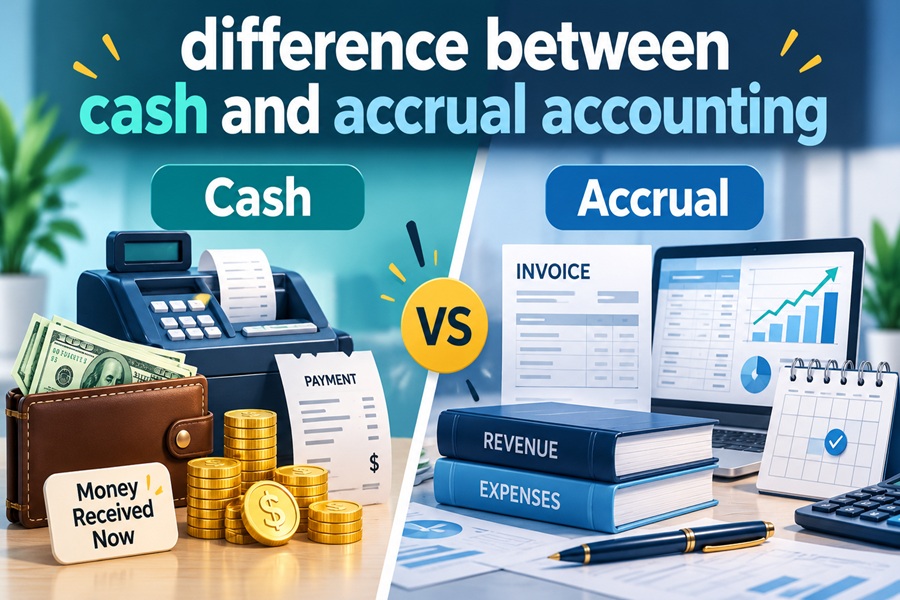
At the end of January, a small design studio looks at two reports. One says the business made 11,000. The other says it lost 2,900. Nothing is wrong with either report. They simply answer different questions.
That gap, between what was earned and what was collected, is the entire difference between accrual and cash accounting. Once you see it in numbers, the textbook definitions become obvious.
The two rules in plain words
Cash accounting records a sale when the money arrives and an expense when the money leaves. If it is not in the bank, it did not happen yet.
Accrual accounting records a sale when it is earned and an expense when it is incurred, regardless of when cash moves. If you delivered the work, the revenue counts. If you received the service, the cost counts.
Accrual follows a matching idea. Revenue and the costs that helped produce it should land in the same period, so each month’s profit reflects the real activity of that month.
The studio’s January, both ways
Northlight Design had this month:
- A large branding project was delivered and invoiced for 12,000. The client will pay in March.
- A small logo job for 3,000 was delivered and paid straight away.
- Rent of 1,500 was paid.
- The annual software subscription of 2,400 was paid in January and covers twelve months.
- Office supplies of 500 were received in January, to be paid in February.
- A freelancer was paid 2,000 in January for work done in December.
- The same freelancer did 1,800 of January work, which will be paid in February.
Here is how each method sees the month.
| Line | Cash basis | Accrual basis |
|---|---|---|
| Revenue | 3,000 | 15,000 |
| Rent | 1,500 | 1,500 |
| Software | 2,400 | 200 |
| Office supplies | 0 | 500 |
| Freelancer | 2,000 | 1,800 |
| Total expenses | 5,900 | 4,000 |
| Profit or loss | (2,900) | 11,000 |
The cash view says January was painful, because the big invoice has not been collected and the software was prepaid. The accrual view says January was strong, because the studio earned 15,000 of work against 4,000 of costs. Both are true. One describes the bank account, the other describes the business.
What accrual does behind the scenes
To get from raw transactions to accrual figures, accountants post adjusting entries at the end of each period.
- Accrued revenue: work done but not yet billed is recognized.
- Accounts receivable: invoices sent but unpaid sit as an asset.
- Prepaid expenses: costs paid ahead, like the software, sit as an asset and are released month by month.
- Accrued expenses: costs incurred but unpaid, like the freelancer’s January work, are recorded as a liability.
- Deferred revenue: cash received for work not yet delivered is a liability until the work is done.
- Depreciation: the cost of long lived equipment is spread across its useful life.
Cash accounting skips all of these. That is why it is quicker and why it can mislead.
The trade offs
| Cash basis | Accrual basis | |
|---|---|---|
| Simplicity | Very simple, mirrors your bank | More work, needs adjusting entries |
| Reflects true performance | Can swing wildly with payment timing | Smoother and closer to economic reality |
| Cash visibility | Excellent, profit roughly equals cash | Needs a separate cash flow view |
| Tax timing | Can defer tax by delaying invoices or accelerating payments | Tax can arise before cash arrives |
| Lender and investor appeal | Often limited | Standard and expected |
| Fit for inventory and credit sales | Awkward | Natural |
The sharpest risk with accrual is paying tax on profit you have not collected. The sharpest risk with cash is believing a good bank balance means a good business, when a pile of unpaid bills is waiting behind it.
Who is allowed to use which
In the United States, the rules for tax reporting are specific. A business can generally use the cash method if its average annual gross receipts over the previous three tax years are at or below an inflation adjusted limit. That figure is 32 million for tax years beginning in 2026, up from 31 million in 2025 and 30 million in 2024. Individuals and most small businesses sit far below it. A few categories face restrictions regardless of size, such as tax shelters, and certain corporations and partnerships with corporate partners must pass the receipts test.
Cross the limit and accrual becomes mandatory from the year you fail the test. Small businesses under the limit also get a helpful side benefit, since they can handle inventory in simplified ways rather than running full accrual inventory accounting for tax purposes.
Separate from tax, standard financial reporting rules require accrual. Any company with outside investors, bank covenants or an audit requirement will be pushed that way regardless of its tax method. Other countries set their own thresholds, so a business outside the United States should check local rules.
The middle road
A hybrid method mixes the two, for example accrual for sales and inventory but cash for everything else. It is permitted in some situations, but any approach that includes cash still has to pass the eligibility tests above, so hybrid does not work as a loophole for larger businesses.
Many small firms use a practical version without calling it that. They keep their tax filing on the cash method and run internal reports on accrual, so owners see real profitability while the tax return stays simple. Modern cloud accounting tools let you flip a report between cash and accrual views with one setting, which makes this approach easier than ever.
Switching methods
A change of accounting method for tax is not a casual decision. It usually needs the tax authority’s consent, a formal filing, and an adjustment to catch up income or deductions that would otherwise be counted twice or never. Switching from cash to accrual often creates a one time adjustment, because receivables and payables suddenly come onto the books. Planning the change with an accountant before the year starts avoids ugly surprises.
A quick way to decide
- Freelancers and sole traders with little inventory: Cash is usually right. It is simple, and your bank account tells you where you stand.
- Growing service firms with slow paying clients: Consider tracking accrual internally even if you file on cash, so you can see profit and receivables clearly.
- Product sellers with stock: Accrual style inventory tracking pays off quickly, whatever the tax method.
- Companies seeking loans, investors or an eventual sale: Use accrual early. Switching later is harder than starting properly.
- Businesses nearing the receipts limit: Prepare ahead, because the switch will be required, not optional.
Mistakes to avoid
Treating profit as cash is the classic one. An accrual profit of 11,000 does not mean 11,000 is available to spend. Another is mixing methods inside one set of books, recording some sales when invoiced and others when paid, which produces numbers that satisfy nobody.
The short version
Cash accounting tells you what is in your pocket. Accrual accounting tells you what your business has actually done. Small, simple operations can live happily on cash. Anyone with credit customers, stock, outside funding or growth plans needs the accrual picture, and the smartest owners keep an eye on both.

Leave a reply


-
Prospecting Explained for Sellers Starting From Zero
Sales prospecting is the work of finding potential customers who fit what ... -
-
-
-
-
-