Prospecting Explained for Sellers Starting From Zero
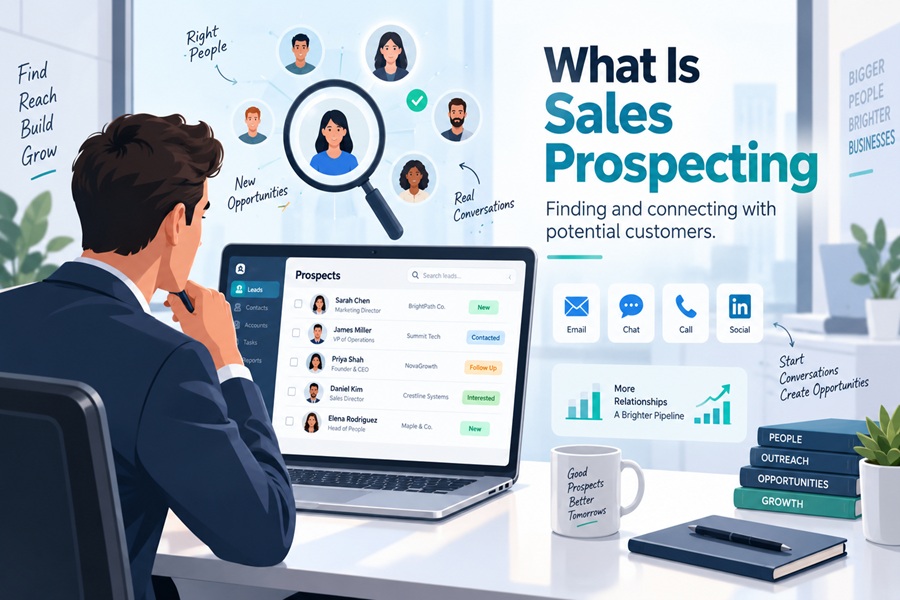
Sales prospecting is the work of finding potential customers who fit what you sell, researching them, and reaching out to start a conversation. It sits at the very beginning of the sales process, before any demo, proposal or negotiation. Without it, a sales pipeline depends entirely on inbound leads, and very few businesses can grow on inbound alone.
If the word feels dated, think of a prospector panning a river. Most of what comes up is gravel. The skill is in choosing the right river, sorting quickly and recognizing gold when it appears.
Prospecting is not the same as lead generation
The terms get blended, but they describe different jobs. Lead generation is usually a marketing activity that attracts many people at once through content, ads, events or search. Prospecting is usually a sales activity that targets specific companies and people, one by one, with direct outreach.
The two meet in the middle. A lead from a webinar still needs prospecting work: research, qualification and a personal follow up before it becomes a real opportunity.
Who you should prospect
Good prospecting starts with an ideal customer profile, a clear description of the companies or people most likely to buy and succeed with your product. For B2B sellers that might include industry, company size, location, technology used and the problems they typically face. For a local service business it might be homeowners in certain neighborhoods with older houses.
Inside each target company, you also need buyer personas: the job titles that feel the problem, the ones that control budget and the ones who can block a deal.
The best profiles come from your existing customers. Look at who bought, who stayed and who grew. Then look for more companies like them.
The main prospecting methods
Phone calls. Still effective for many industries, especially when calls are researched and short. Respect calling rules, including the national Do Not Call registry and restrictions on automated dialing.
Email. Scalable and easy to personalize, but more tightly regulated by inbox providers than ever (more on that below).
LinkedIn and social selling. Connecting with prospects, commenting on their posts and sharing useful insights builds familiarity before a direct message.
Referrals and introductions. Usually the highest converting source. A warm introduction from a happy customer opens doors that cold outreach cannot.
Events and communities. Trade shows, local business groups, online communities and industry associations put you in the same room as buyers.
Trigger based outreach. Reaching out after a relevant event, such as a funding round, a new executive hire, an expansion or a job posting that signals a need.
Most strong prospectors combine several of these in a planned sequence rather than relying on one channel.
The rules have changed for cold email
Bulk cold email used to be a numbers game. Major inbox providers changed that. Google and Yahoo now require bulk senders to authenticate their domains with SPF, DKIM and DMARC, offer easy one click unsubscribe on marketing messages, and keep spam complaint rates very low, under 0.3 percent. Microsoft introduced similar requirements for Outlook senders.
In practical terms, sloppy mass outreach now lands in spam or gets blocked entirely, and it can damage the reputation of your main company domain. Prospectors who send fewer, well researched emails from properly configured domains reach more inboxes than those who send thousands of generic ones.
Laws matter too. The CAN SPAM Act in the US requires accurate sender information and a working opt out. GDPR in Europe and Canada’s anti spam law set stricter consent rules. Check the rules for every country you prospect into.
Buyers are harder to reach and quicker to ignore
Gartner’s buyer research shows a clear trend: 67 percent of B2B buyers now say they prefer a rep free buying experience, and 73 percent actively avoid suppliers who send irrelevant outreach. That does not make prospecting pointless. It makes relevance non negotiable.
A prospecting message works when it shows the buyer you understand their situation, offers something useful, and asks for a small next step. Something as simple as “I noticed you’re hiring three warehouse supervisors, which usually means scheduling gets messy. We helped a similar distributor cut overtime by a fifth. Worth a 15 minute call?” beats a paragraph about your company’s history.
How AI is changing prospecting
AI has become a regular part of prospecting work. Salesforce’s State of Sales research found that 92 percent of sellers using AI agents say they benefit prospecting, and sellers expect agents to cut prospect research time by about a third. Top performers were 1.7 times more likely than underperformers to use AI agents for outreach.
The useful applications are research summaries, account prioritization, first drafts of messages and logging activity automatically. The risk is using AI to send more generic messages faster, which runs straight into the spam rules and buyer fatigue described above. The sellers getting results use AI to understand prospects better, then write or edit the message themselves.
A weekly prospecting rhythm
Consistency beats bursts. A rep who prospects a little every day builds a steadier pipeline than one who prospects for a whole day once a month.
| Day | Focus | Example output |
|---|---|---|
| Monday | Build and refresh target list | 25 new accounts matching your ideal profile |
| Tuesday | Research and first outreach | Personalized first touches to the new accounts |
| Wednesday | Calls and social engagement | Calls to warm accounts, comments on prospects’ posts |
| Thursday | Follow ups with added value | Second and third touches with a case study or insight |
| Friday | Referrals and review | Ask two customers for introductions, review reply rates |
Block the time on your calendar and protect it. Prospecting is the first task to disappear when the week gets busy, which is exactly why pipelines dry up a month later.
Measuring whether it works
Track a few simple numbers: accounts contacted, reply rate, meetings booked, and how many of those meetings become qualified opportunities. If replies are low, look at targeting and message relevance. If meetings are booked but rarely qualify, tighten the ideal customer profile.
Prospecting rarely feels glamorous. It is research, writing, calling and patient follow up. But it is the part of sales that a seller controls most directly, and the reps who treat it as a craft rather than a chore tend to have the fullest pipelines when the quarter ends.


Leave a reply
-
Prospecting Explained for Sellers Starting From Zero
Sales prospecting is the work of finding potential customers who fit what ... -
-
-
-
-
-